A robot,
built in the open.
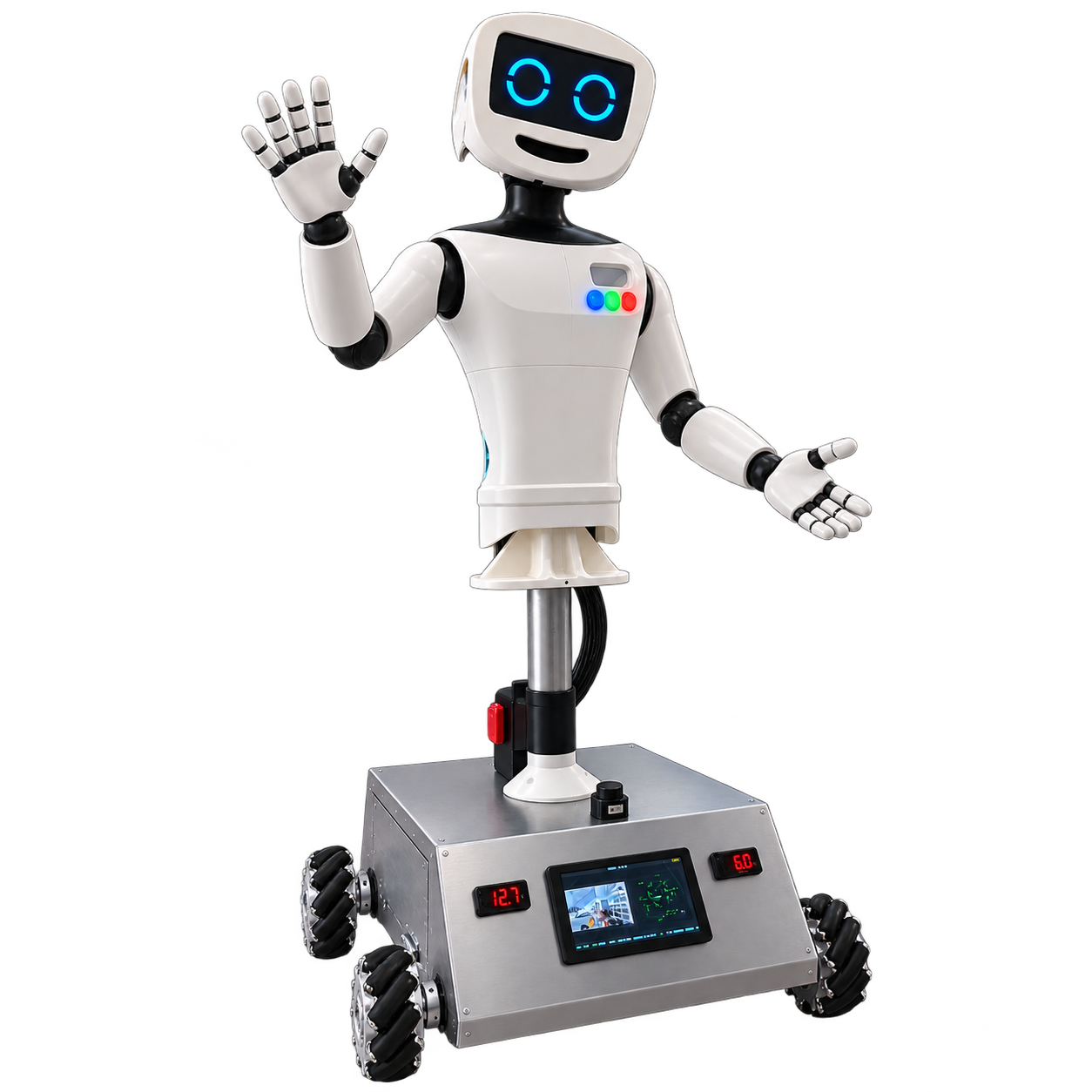
ArmBot is a mobile humanoid built by grafting an open-source head and arms onto a custom four-wheel base, split across three boards that each own one job: moving, seeing, and talking. Every capability on this page shipped, was reviewed, and was dated — this is the record of that, from the first commit forward.
In plain terms: ArmBot is a robot that can move through a space, see and recognize people, talk naturally, and learn to help with physical work.
Today: navigation, voice interaction, face recognition,
person following, and remote operation.
Next: safe object handling and
practical task assistance.
Physical AI people
can teach, trust,
and work alongside.
AI has become useful behind a screen. ArmBot is being built to bring it into the physical world — where people learn, work, and solve problems together.
We are creating an open, modular humanoid platform that can move through real spaces, understand people, communicate naturally, and eventually perform useful physical tasks. The goal is not a closed demo. It is a robot that can be taught, improved, and deployed in the places where embodied intelligence matters.
Learn on a real platform
A living robotics lab for students to learn AI, perception, control, and human–robot interaction on a real, understandable platform.
Support hard-to-staff work
A path toward robots that support repetitive, difficult-to-staff, or physically demanding work — starting with safe navigation, awareness, and natural interaction.
Test embodied AI for real
A practical platform for testing embodied AI outside simulation: perception, autonomy, safety, manipulation, and human trust in real environments.
Phase 1 establishes safe mobility, perception, and interaction. Phase 2 gives that intelligence useful hands.
Mobile perception platform
Head, torso, and a four-wheel omni base. Path planning, obstacle avoidance, person recognition and following, natural voice interaction — all running today.
In progressManipulation
The arms and hands are already built — shoulder to fingertip, both sides. What's ahead is teaching them to grasp and handle objects autonomously, on the 3D spatial detection Phase 1 already produces.
Hardware readyOpen source underneath.
Rebuilt on top.
The head, arms, and hands started from pib.rocks, an open-source humanoid platform — used as a starting point, not a finished product. Everything below the neck is custom, and so is nearly the entire software stack.
pib.rocks
open source
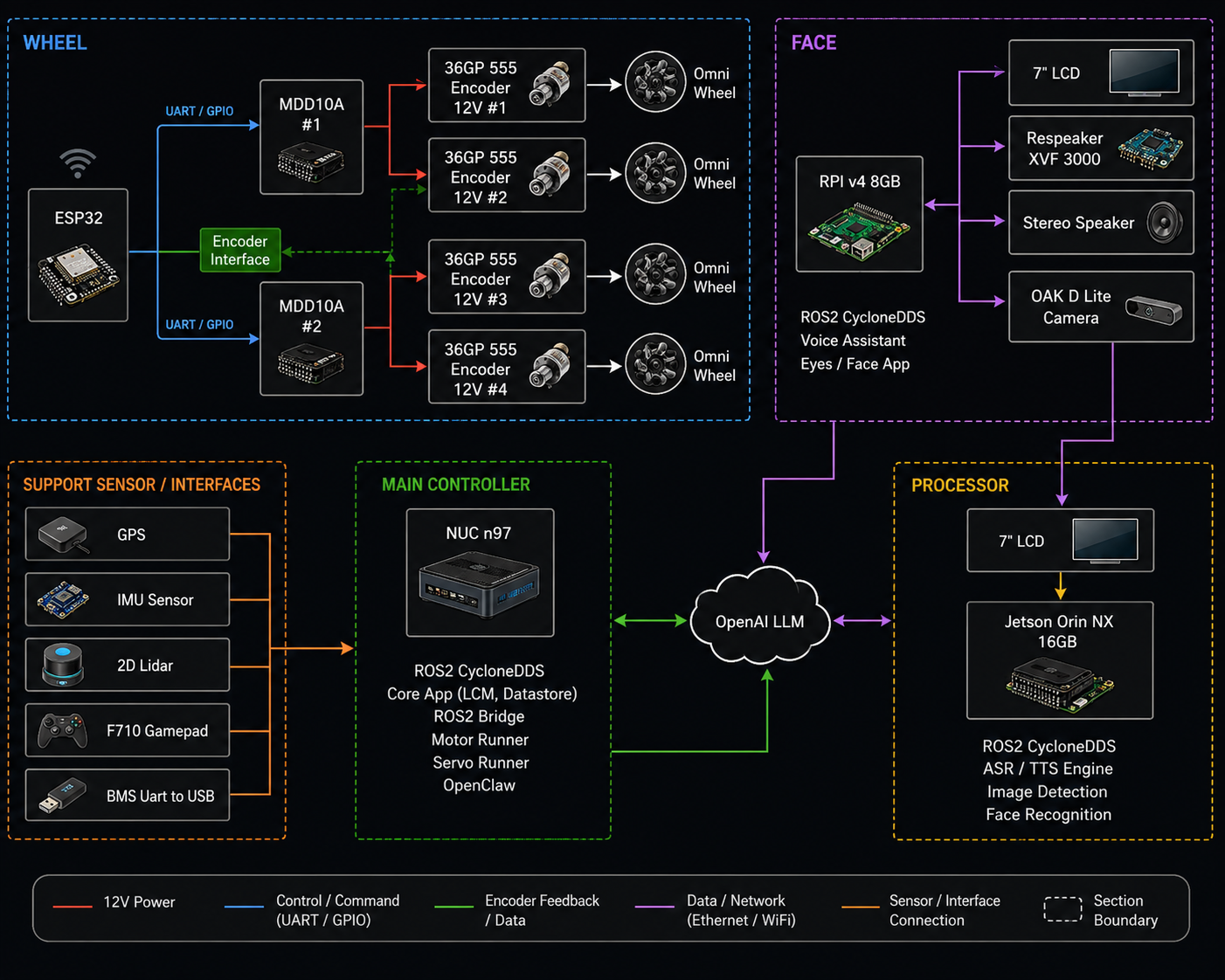
pib's own reference design is a stationary desk humanoid — it doesn't move. The four-wheel omni base underneath ArmBot replaces that mount entirely, and two whole boards in the compute layer below (Jetson, NUC) don't exist in the stock pib design at all. Navigation, perception, the voice pipeline, the reasoning "brain," every safety interlock, and this dashboard were all built from scratch on top of pib's head, arms, and hands.
Raspberry Pi
- Face & display
- Head servos, gaze tracking
- Mic array, wake word
- Conversational front-end
Jetson Orin
- Camera perception, face ID
- SLAM + Nav2 navigation
- Speech recognition & synthesis (GPU)
- Web dashboard
Intel NUC
- Real-time motion control
- Four-wheel omni drive
- IMU / GPS
- The "brain" — reasoning & tools
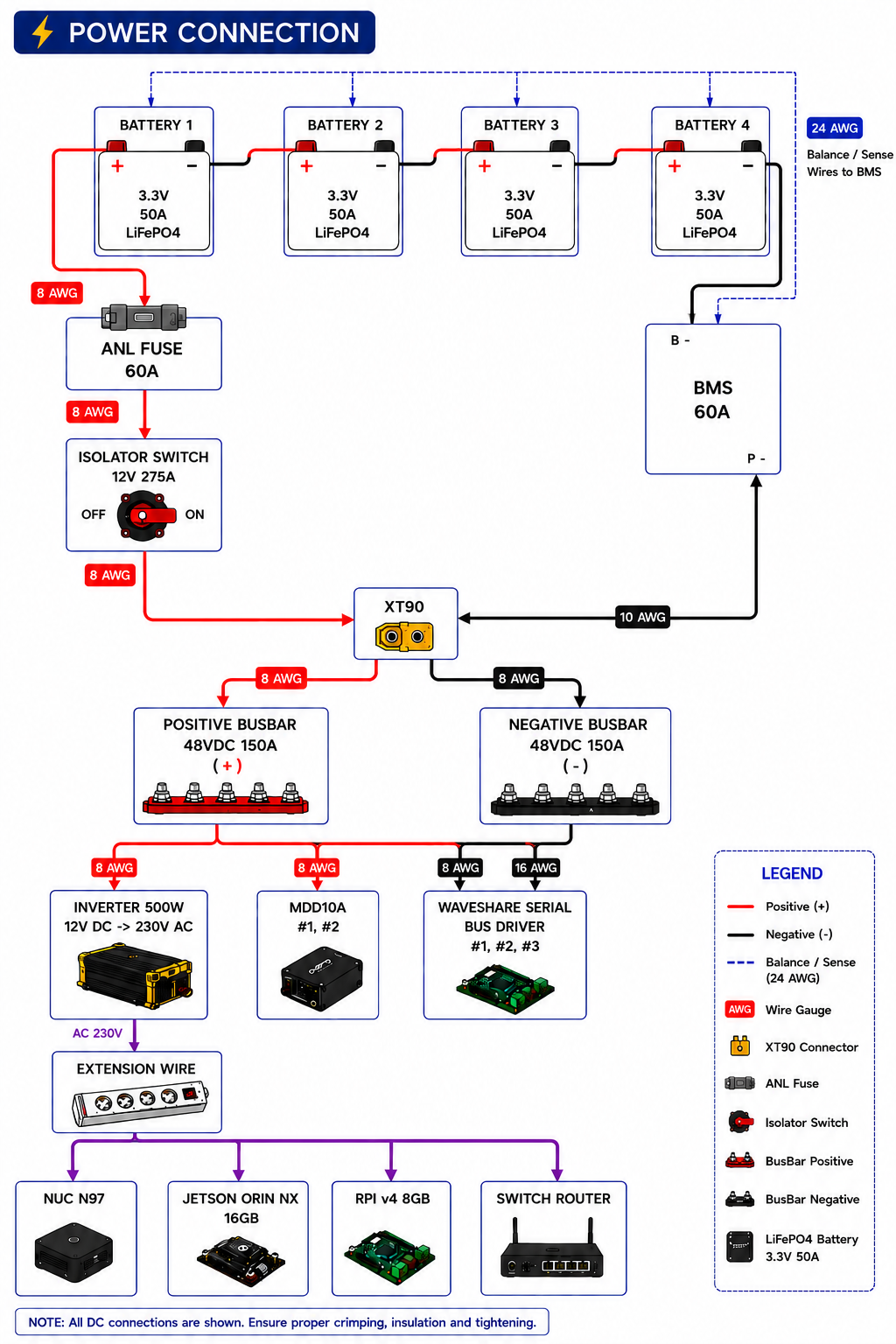
Battery & Distribution
- LiFePO4 bank, 60A BMS
- 48V busbars, 500W inverter
- Fused + isolator switch
Four-Wheel Omni Base
- ESP32 motor controller
- Dual MDD10A drivers
- Encoder feedback per wheel
Perception Inputs
- 2D LiDAR, OAK-D depth camera
- IMU + GPS
- Gamepad override (safety)
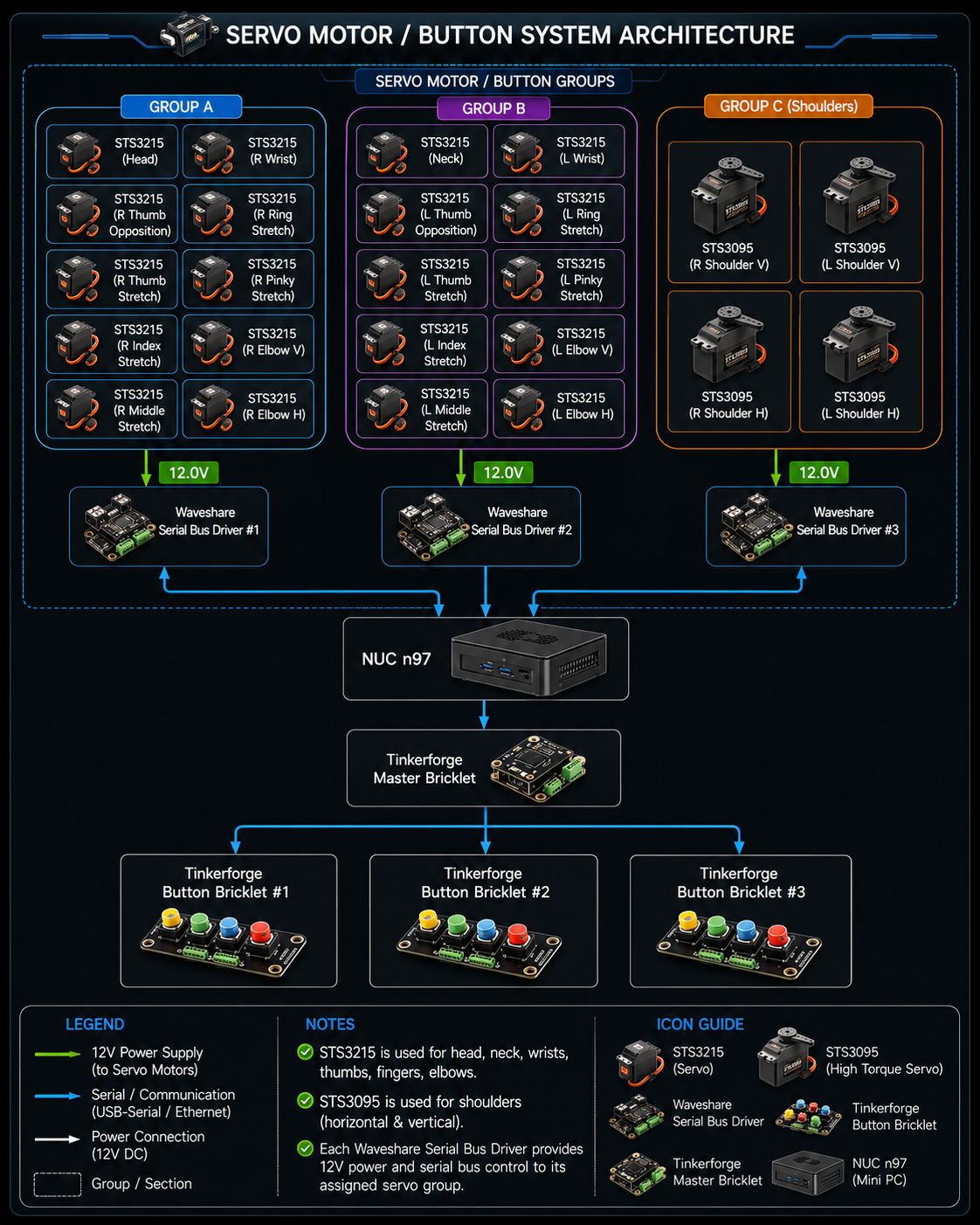
Arms & Hands
- Shoulder / elbow / wrist, both sides
- 5 driven digits per hand, incl. thumb opposition
- Hardware complete — autonomy is Phase 2
The cards above are the plain-language summary — these are the real wiring and system diagrams behind them. Click any to see it full size.
Newest first.
Every entry below is a real, dated milestone from the project's own build record. New entries get added to the top as they happen — this list only grows.
Teaching the hands
to work on their own.
Follow the build.
This page updates as new milestones ship — check back, or reach out directly if you'd like a closer look at the robot, the code, or what's planned next.